
By Mike Bandar, Co-founder of Waybook.
For an agency of 10 to 200 people, Waybook is the SOP software to buy when the real problem is that the quality of delivery depends on who is staffed on the account: it holds the delivery playbook, the per-client exceptions and the training in one place, shows per person who has read each procedure, and publishes its price. Scribe is the capture tool to run beside it, not instead of it. Process Street is the pick if the job is running client onboarding as a checklist every time. Notion is the free wiki if you accept that nobody can prove anything was read. This guide compares seven tools against the three tests an agency sets, for owners and operations leads at marketing, digital, creative and consulting agencies. For the comparison across every business type, see our catch-all SOP software comparison.
Published October 22, 2026. Prices captured and dated in the table.
What an agency needs that a generic SOP tool does not give it
Most SOP software assumes one company doing one thing the same way every time. An agency does the same work for twenty clients who each negotiated something different, with teams that change by project. Three things follow.
One delivery standard, and the exceptions beside it. The brief, the kickoff, the revision rounds, the reporting cadence: the standard version of each is the agency's IP. Client A agreed three rounds, not two; client B wants the report on Thursdays. If the exception lives only in the account manager's head, the standard gets followed correctly and the client is still annoyed. The tool has to hold the standard once and the per-client exception next to it, not in a separate document nobody opens.
The process stays when the person leaves. Agencies run on people who know how things are done here, and those people get promoted, poached or burnt out. A playbook with an owner, a review date and one current version is the only thing that survives the handover. A folder of Google Docs with twelve versions of the onboarding deck is not.
Contractors and freelancers onboard in a day and leave cleanly. Half the people touching a project may not be employees. They need the three procedures for their role, read access to nothing else, and a record that they read them, for the day a client asks who worked on the account and whether they knew the brand rules.
A capture tool answers none of these on its own, and that is where most agency SOP stacks break: they are excellent at making a guide and have nowhere to put it that proves it was read.
Seven tools at a glance, and our verdict
Tool | Verdict for an agency | Pricing |
|---|---|---|
Waybook | Our pick for agencies of 10 to 200 people: delivery playbook, per-client exceptions, role-based onboarding and read confirmation in one tool, AI drafting from a description, contractor access by role, price published. | From $99 a month billed annually, 20 members included, then $5 a member. 7-day free trial. |
Scribe | The best capture tool for a software process: record it once, get a step-by-step guide. A guide maker, not a playbook; no training paths and no read confirmation. | Basic free; Pro Team $23 a seat a month from 5 seats (captured October 22, 2026). |
Trainual | Structured onboarding curricula with tests and completion tracking; built for one company's training sequence, heavier to set up, and the price is a sales call. | Core $249 a month, captured in-app August 2026; no published pricing. |
Whale | SOPs and training in one, with a free tier to start on and a screen recorder; priced per creator, so a few authors and many readers is cheap and many authors is not. | Free for 1 creator and 10 members; Scale $249 a month billed yearly (captured October 22, 2026). |
Process Street | Runs a procedure as a checklist with required fields and approvals. The pick when client onboarding must happen the same way every time; documentation is secondary. | No published pricing; contact sales (October 22, 2026). 14-day trial. |
SweetProcess | Plain procedures, policies and processes in one library at a flat rate. Reliable, dated, no training paths. | $99 a month for up to 10 users, $5 each extra (captured October 22, 2026). |
Notion or a shared drive | Fine for the first ten procedures and already paid for. No read confirmation, no role paths and no owner on a page, so the exceptions drift back into heads. | Notion Plus $10 a seat a month, Business $20 (captured October 22, 2026). A shared drive is already paid for. |
The verdict column is written for an agency owner or operations lead with 10 to 200 people. A holding group with its own learning and development team is a different buyer.
The seven tools for an agency
1. Waybook
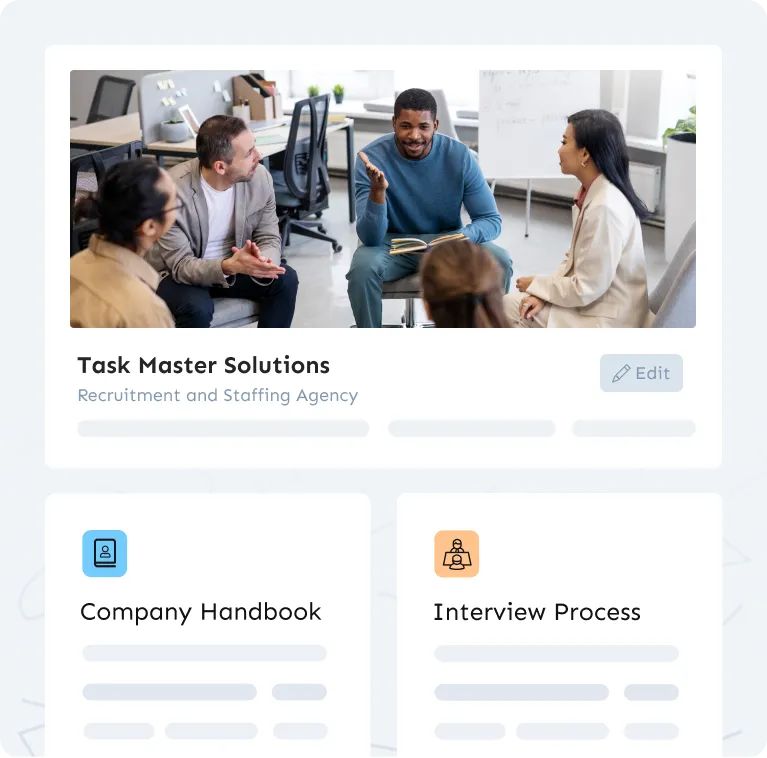
Waybook is a company playbook: procedures, onboarding paths, a searchable knowledge base, read confirmations and tests in one place, organized the way the agency runs. For an agency that means a section per service line for the standard, a page per client for the exceptions, and a role path for account managers, designers and contractors that assigns itself when someone joins a project.
What matters here: AI drafting from a plain description or a recording, so the person who knows the process gets it out of their head in minutes without writing it; groups and permissions, so a freelancer sees the three procedures for their role and nothing about other clients; read confirmation and short tests per person, which is the answer when a client asks who on the account knew the brand rules; version history and review dates, so the playbook does not go stale when its author leaves; and Waybook Ask, which answers a team member's question from your own procedures instead of from the account manager's inbox. Capterra rates it 4.9 from 56 reviews.
Our limitation: Waybook is not a project management tool and does not run tasks. The client work still lives in Asana, ClickUp or Monday; Waybook is where the way you do that work lives, and the two link to each other.
2. Scribe
Scribe records a process while someone does it in the browser and turns the clicks into a step-by-step guide with screenshots. For an agency that solves the real bottleneck: the person who knows the process has no time to write it. A guide that took four hours takes four minutes.
What it does not do is hold the result. There are no role paths, no read confirmation and no per-client layer, so most agencies that love Scribe end up with hundreds of guides and no answer to who read which. Run it for capture and give the output a home. Our comparison is at Scribe alternatives for process documentation.
3. Trainual
Trainual is the best-known name in the category: subjects, lessons and tests in a fixed order, with completion tracking by role. Agencies that want one training sequence for every new hire and have an operations person to build it will find it familiar.
The costs are setup and price. Trainual rewards a dedicated admin building the curriculum up front, and its Core plan was captured at $249 a month in August 2026 with no public pricing page. It is also built for one company's way of working, so the per-client exception has no natural place. Our side-by-side is at Waybook vs. Trainual.
4. Whale
Whale combines SOPs and training, has a screen recorder, and offers a free tier for one creator and ten members, the cheapest way for a ten-person studio to start. Documentation is quick and training assignments work.
The pricing is per creator. An agency where two people write and forty read is well served; one where every account lead maintains their own client pages pays for each of them, and the Scale plan that unlocks training flows sits at $249 a month billed yearly (October 22, 2026).
5. Process Street
Process Street turns a procedure into a workflow that runs: a checklist with required fields, conditional steps, approvals and a record of who did what. If the problem is that client onboarding or the monthly report is done differently every time, this is the shape of tool that fixes it.
It is a weaker fit for the rest: the brand rules, the policies, the training a new hire reads before touching an account. Documentation is secondary to execution, and the price is a sales call, with no published plan prices at October 22, 2026. Many agencies run it beside a playbook tool.
6. SweetProcess
SweetProcess is a plain library of procedures, policies and processes at a flat $99 a month for ten users (October 22, 2026). It does the documentation job without fuss and has been doing it for years.
It has no onboarding paths, no tests and little that is agency-specific, so the per-client layer and the contractor question are left to you. A reasonable choice for a small firm that wants procedures written and nothing else. Our comparison is at Waybook vs. SweetProcess.
7. Notion or a shared drive
Every agency has a version of this: the operations wiki in Notion built the month the fifth person joined, or the Google Drive folder called Processes. It is free or already paid for, and for the first ten procedures it works.
What it cannot do is prove anything or hold a standard. No read confirmation, no owner on a page, no path for a new starter, so the twelve-version onboarding deck is the normal state. Most agencies outgrow it the month a good account manager leaves. Our comparison is at Waybook vs. Notion.
What is the fastest way to build SOPs for a digital agency?
Start from what already happens, not from a blank page. Three routes, in order of effort:
Describe it out loud. The account lead explains the kickoff the way they would to a new hire, in five minutes, and an AI draft turns that into a procedure to correct. In Waybook that is the AI SOP creator; the first draft is wrong in three places and right in thirty, and correcting it is faster than writing.
Record it once. For software processes, setting up a campaign or pulling the monthly report, a capture tool like Scribe or Waybook Shots records the clicks and writes the steps. Give the output a home with an owner, or it joins the pile.
Harvest the last handover. The Loom someone recorded before they left, the Slack thread that explains the exception, the deck from the last onboarding: paste them in and draft from them.
An agency that does this for the five procedures it is asked about most has its first week's work done. The slow route, a documentation sprint where the operations lead writes everything, produces forty half-finished pages and a cancelled subscription in month four.
What should an agency document first?
Not the employee handbook. In this order:
Client kickoff and onboarding. What the client sends, what you send back, who is on the first call and what is agreed by the end of it. This is the procedure every new account lead gets wrong first.
Scope and revision rules, with the per-client exceptions. The standard says two rounds. The page for client A says three, and who agreed it. This is the IP, and it is the page that stops the client being annoyed when the process was followed.
The handoff from sales to delivery. What was promised, what was priced, what the delivery team needs to know before the kickoff.
Reporting. What goes out, when, in what format, who signs it off before it leaves.
Role paths for the two roles you hire most, and one for contractors. Each assigns itself on day one with a check at the end of the first week; the contractor path is three procedures and read access to nothing else.
Who may change what. The standard has an owner and a review date. Account leads edit their client's exceptions and nothing else.
An agency with these six documented and read is ahead of most of the firms it pitches against.
How long does it take to set up SOP software for a marketing agency, and where do I start?
A ten to fifty person agency can have its first five procedures, one role path and read confirmation live in a day in Waybook or Whale: setup is self-serve, AI drafting does the writing, and the structure is three sections, how we deliver, our clients, our people. Plan a week to get the standard for one service line complete and a month for everything you are asked about weekly. Trainual takes longer because the curriculum has to exist before anyone is assigned anything; Process Street takes longer because each workflow is built, not written. Start with the service line that has the most people on it, and the one client whose exceptions cause the most rework.
Is a free tool good enough for a marketing agency?
For a studio under ten people, often yes: Whale's free tier, Scribe's Basic plan or Notion's free plan will hold the first ten procedures. The free stack stops working on one of three days. The day a client asks who on their account was trained on the brand guidelines and nobody can say. The day the account manager who knew the exceptions resigns. The day the second office or the first ten contractors need a different view of the same playbook. Each of those is a proof or permissions problem, which is what the paid tools charge for. The cost of waiting is measured in rework on the account that got the old version.
How hard is it to switch tools?
Less hard than staying. Procedures are text, screenshots and a few videos; every tool here exports them and most import them. Waybook imports existing documents and offers a free data migration on paid plans, so the Notion wiki or the Drive folder comes across as a structure to prune rather than a blank page. The slow part is not the move. It is deciding which of the twelve versions is current, and a switch is the one moment the whole agency is willing to answer that.
Agencies on Waybook, from the interviews
No agency has a published success story on our site yet, and we would rather say so than borrow one. What follows is from our customer interviews, with the agency unnamed.
A 160-person marketing agency came to Waybook with two problems. The first was the answer machine. "I can't tell you how many conversations... the questions we get asked repetitively," their VP of HR told us. The second was proof. Their CTO put it this way: "We get asked quite often from either vendors or customers: we want to see all of your policies. How are you ensuring that your staff have looked at these policies? How are you doing reminders?" Their previous attempt was Google Classroom, which their operations director called "a little bit clunky, also kind of difficult to maintain." Both problems are the same question, can you show who read it, and that question is why a playbook with read confirmation beats a wiki for an agency that sells to companies with procurement teams.
Frequently asked questions
As a first-time manager: what is the fastest way to build SOPs for a digital agency?
Start from what already happens. Have the person who knows the process describe it out loud the way they would to a new hire, and let an AI draft turn the five minutes into a procedure to correct; for software processes, record the clicks once with a capture tool and give the guide a home with an owner. Five procedures this way is a week's work. A documentation sprint where one person writes everything is the slow route and usually ends with forty half-finished pages.
As an operations manager: how do I write standard operating procedures for a digital agency, and what should I document first?
Write the standard once and the per-client exceptions beside it, never mixed. Document in this order: client kickoff and onboarding; scope and revision rules with each client's exceptions; the handoff from sales to delivery; reporting, what goes out, when and who signs it off; role paths for the two roles you hire most and one for contractors; who may change what. An agency with those six documented and read is ahead of most of its competitors.
As a founder wearing too many hats: what is the best SOP software for a marketing agency, and is a free tool good enough?
For an agency of 10 to 200 people, Waybook: the delivery playbook, the per-client exceptions and the training in one place, read confirmation per person, AI drafting, and a published price from $99 a month billed annually with 20 members included. A free tool, Whale's free tier, Scribe's Basic plan or Notion, is good enough for a studio under ten people until the day a client asks who on their account was trained on the brand rules, or the account manager who knew the exceptions leaves. Both are proof problems, and proof is what the paid tools charge for.
How long does it take to set up SOP software for a marketing agency, and where do I even start?
A ten to fifty person agency can have its first five procedures, one role path and read confirmation live in a day in Waybook or Whale, because setup is self-serve and the AI draft does the writing. Plan a week for one complete service line and a month for everything you are asked about weekly. Start with the service line that has the most people on it and the one client whose exceptions cause the most rework. Trainual and Process Street take longer because the curriculum or the workflow has to be built before anyone is assigned anything.
Which SOP platform should I buy for a digital agency, and how hard is it to switch tools?
Buy a playbook tool first and a capture tool beside it, not the other way round: Waybook or Whale for the playbook, Scribe or Waybook Shots for capture, Process Street only if the problem is running client onboarding as a checklist every time. Switching is less hard than staying. Procedures are text, screenshots and a few videos, every tool here exports them, and Waybook imports existing documents and offers a free data migration on paid plans. The slow part is deciding which of the twelve versions is current, and a switch is the one moment the whole agency will answer that.
Is it worth paying for SOP software at a ten-person agency?
It is worth paying the day you cannot show who read a procedure, which for most agencies arrives with the first contractor, the first client audit or the first resignation of someone who held the exceptions in their head. Until then a free tier or a shared drive works, and it stops working without warning. At $99 a month the question is whether one afternoon of rework on the account that got the old version costs more than that, and at agency rates it does.
Our recommendation
For agencies of 10 to 200 people, Waybook is the right choice: the delivery playbook, the per-client exceptions, role-based onboarding and read confirmation in one tool, AI drafting from a description, contractor access by role, and a published price. Scribe beside it for capture. Process Street beside either if client onboarding must run as a checklist. Notion if you are under ten people and can live without proof for now. Start the 7-day free trial, describe the one procedure your team asks about most, and see who has read it by Friday.